
Stop Treating Context Like Memory: The Database Architecture Behind Long-Running
The future of agent memory is not bigger context windows. It is better storage, retrieval, indexing, and forgetting systems wrapped around the model.

What This Blog Covers
Why context windows fail
Memory versus retrieval systems
Context is not storage
The hidden cost of recall
Forgetting as a feature
Designing memory architectures
Every few months, the industry celebrates a larger context window.
100K tokens.
1 million tokens.
10 million tokens.
The assumption is always the same. If the model can see more information, it will become more useful. If memory problems exist, they can be solved by stuffing more data into the prompt.
That sounds reasonable until you look at how software systems have handled memory for the past fifty years.
When databases grew larger, engineers did not solve the problem by loading the entire database into RAM. When web applications accumulated more users, engineers did not solve the problem by putting every user record into every request.
They built storage systems.
They built indexes.
They built caches.
They built retrieval layers.
They built architectures that separated memory from computation.
For some reason, much of the AI industry is attempting to relearn this lesson the hard way.
Agent memory is not a context-window problem.
It is a database problem.
The Industry Is Solving the Wrong Problem
The current conversation around agent memory is dominated by context windows. New model releases often focus on how many tokens can fit inside a prompt, and benchmarks frequently reward systems that can process larger and larger amounts of information.
This creates the impression that memory scales linearly with context size.
If a model struggles to remember something, simply provide more context. If it forgets details, increase the window.
The problem is that memory and visibility are not the same thing.
Imagine opening every document on your laptop simultaneously. Technically, all of the information is visible. Practically, finding the right information becomes harder because the signal is buried inside noise.
The same thing happens inside large context windows.
More information does not automatically create better memory. In many cases, it creates worse retrieval.
Context Is Not a Database
Databases exist because memory has structure.
Information can be stored, indexed, queried, updated, deleted, and retrieved according to specific rules. Engineers spend enormous amounts of effort optimizing those operations because they determine whether systems remain usable at scale.
Context windows provide none of those guarantees.
A context window is closer to a temporary workspace than a persistent storage system. Information enters the workspace, competes for attention, and eventually disappears when the session ends.
This distinction matters because many teams treat context as though it were durable storage.
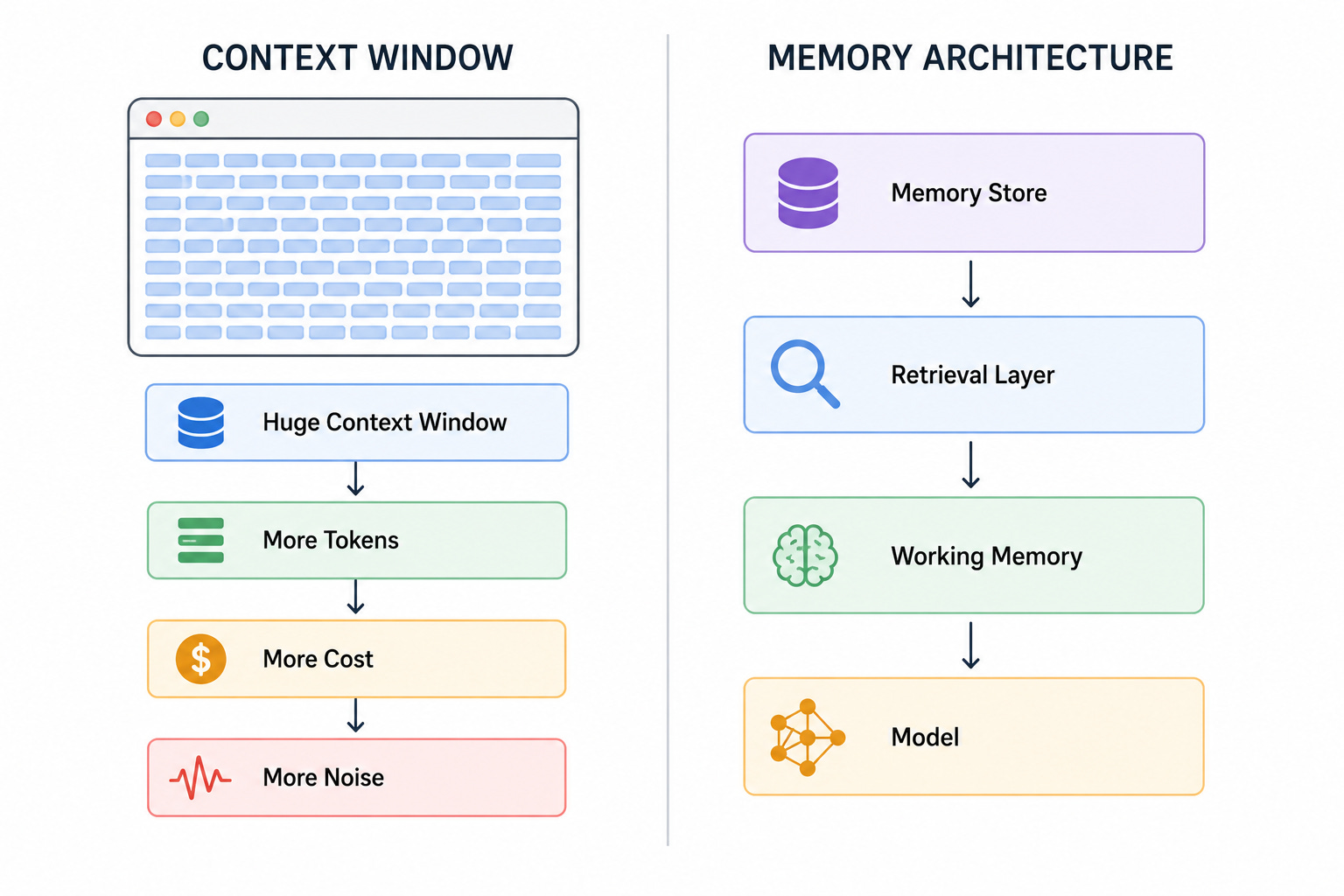
An agent learns something important about a user. Instead of storing that information in a structured system, it gets appended to a growing prompt. The prompt becomes longer, more expensive, and increasingly difficult to navigate.
The architecture starts behaving like a database built entirely from log files.
Eventually, everything slows down.
The Hidden Tax of Large Context
Large context windows create a seductive illusion. They make memory appear free.
In reality, every additional token has a cost.
The first cost is obvious: money. Larger contexts require more processing and increase inference expenses. Organizations often discover that memory-heavy workflows become surprisingly expensive once they reach production scale.
The second cost is latency. Every additional piece of information must be processed before the model can generate an answer. Context growth frequently turns responsive systems into slow systems.
The third cost is the most dangerous.
Retrieval quality begins to degrade.
When thousands of pieces of information compete for attention, the model must determine which details actually matter. As the context expands, that selection process becomes harder rather than easier.
This is not a new problem.
Database engineers have been fighting it for decades.
Why Retrieval Beats Recall
The most successful software systems rarely optimize for remembering everything. They optimize for finding the right thing at the right time.
Search engines do not load the entire internet into memory before answering a query. Databases do not scan every row before returning a result. Modern systems rely on retrieval because retrieval scales.
Agent memory should follow the same principle.
The goal is not maximizing what the model can see. The goal is maximizing the probability that the model sees the information that matters.
This changes the architecture completely.
Instead of building larger prompts, teams begin building better retrieval systems. Context becomes a dynamically assembled resource rather than a permanently accumulated one.
Memory stops behaving like a transcript.
It starts behaving like a database.
The Four Operations Every Memory System Needs
A useful way to think about agent memory is through the lens of traditional data systems.
Every serious memory architecture requires four operations.
First, information must be stored. Important observations, decisions, preferences, and outcomes need durable persistence beyond a single interaction.
Second, information must be retrieved. The system needs mechanisms for locating relevant memories without scanning everything that has ever happened.
Third, information must be updated. User preferences change. Project requirements evolve. Facts become outdated. Stale memory is often worse than missing memory.
Fourth, information must be deleted.
This last operation receives surprisingly little attention.
Many agent architectures treat memory as an ever-growing asset. In reality, unlimited retention creates noise, cost, and retrieval problems. Good memory systems forget.
The database world learned this long ago.
Agent systems are beginning to learn it now.
Why Forgetting Is a Feature
Human memory is selective.
People do not remember every conversation, every email, or every document they have ever encountered. They retain information that remains useful and discard information that no longer matters.
Software systems need similar behavior.
Imagine a coding agent working inside a repository for three years. Thousands of pull requests, design decisions, bug fixes, and temporary workarounds accumulate over time. If every piece of information is treated as equally important, retrieval quality collapses.
The agent becomes overwhelmed by its own history.
This is why forgetting should be considered a first-class architectural capability. Information needs expiration policies, relevance scoring, archival strategies, and retention rules.
The objective is not preserving everything.
The objective is preserving what matters.
Memory Architecture Is Becoming System Design
This is where the conversation begins looking less like AI and more like software engineering.
Questions about memory quickly become questions about architecture.
How should information be partitioned?
What belongs in long-term storage?
What belongs in working memory?
When should retrieval happen?
How frequently should memories be updated?
How do we detect stale information?
These are not prompting questions.
They are database questions.
Engineers preparing for system design interviews often learn that scalability problems are rarely solved by adding more compute. They are solved through better architecture, caching, indexing, partitioning, and retrieval strategies.
The same principle applies to agent memory.
For readers interested in those foundational concepts, the course Grokking the System Design Interview provides a strong framework for thinking about storage, retrieval, scaling, and architectural trade-offs.
The technology has changed.
The engineering principles have not.
The Coming Memory Stack
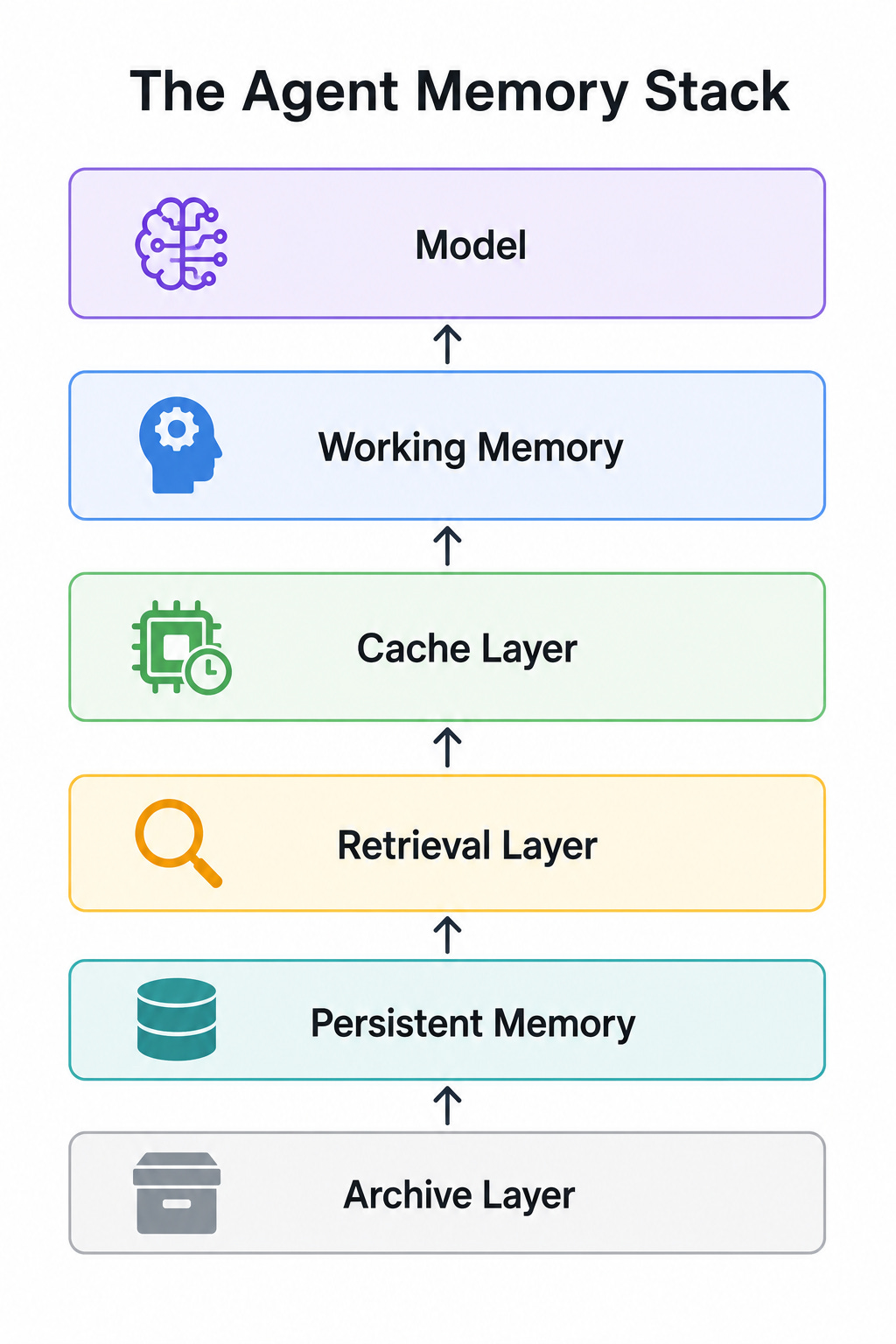
The future of agent memory probably looks less like a giant prompt and more like a layered architecture.
A small working memory contains immediate task context.
A retrieval layer identifies relevant information from long-term storage.
A persistent memory store maintains durable knowledge.
Caching layers accelerate frequently accessed information.
Archival systems manage historical records.
Notice how familiar this sounds.
It resembles a modern application stack far more than a prompt.
That similarity is not accidental.
As agent systems mature, they are inheriting many of the same architectural challenges that traditional software systems faced years ago.
The difference is that the memory layer now serves both humans and models.
Why Bigger Windows Won’t Save You
Larger context windows will continue to matter.
They improve flexibility, reduce fragmentation, and enable workflows that were previously impossible. They are valuable technological improvements.
They are not a complete memory strategy.
A million-token context window does not solve retrieval. It does not solve indexing. It does not solve stale information. It does not solve personalization. It does not solve long-term knowledge management.
Those are storage problems.
Storage problems require storage architectures.
The industry is currently treating memory as a visibility problem. The reality is that memory has always been an information-management problem.
The distinction seems subtle.
It changes everything.
The Database Moment for Agents
Every technology ecosystem eventually reaches a point where data management becomes more important than raw compute power.
The web experienced this transition. Cloud computing experienced this transition. Distributed systems experienced this transition.
Agent systems are approaching the same moment.
The early years were dominated by model capability. Bigger models, larger context windows, and better benchmarks drove most discussions.
The next phase will be dominated by memory architecture.
The organizations that win will not necessarily have the largest context windows. They will have the best memory systems. They will know what to store, what to retrieve, what to forget, and when to do each of those operations.
The future of agent memory is not a bigger prompt.
It is a better database.
For engineers who want a deeper understanding of storage systems, indexing, caching, and retrieval architectures, both Grokking the System Design Interview and Database Fundamentals for Software Engineers provide many of the concepts that are rapidly becoming relevant again in the age of agent systems.