
The Agent That Can't Explain Itself Won't Survive the First Audit
Why production agents need traceable decisions, inspectable reasoning, and audit-ready evidence before they can be trusted.

What This Post Covers
Why “the model decided” fails every audit question, internal and external.
What auditors actually ask — and why the honest answer to most of them is currently “we don’t know.”
The compliance landscape right now: EU AI Act, SOC 2, NIST AI RMF, and what each one demands from your agent.
The four things your agent must be able to prove — not describe, prove.
Why explainability is an architecture problem, not a model problem.
The audit-ready design: what you need to build, and where it goes.
The audit question comes in one of two flavors.
The first is internal: your CISO, your legal team, or your board asks why the agent did that thing — moved that money, closed that alert, flagged that candidate, denied that claim. They want to understand the decision. They want to assign accountability. They want to know if it will happen again.
The second is external: a regulator walks in with a formal request. They want the same things. But now the clock is running, and the answer “the model decided” has a legal consequence attached to it.
Most AI teams are not ready for either conversation. Not because the underlying model is opaque — that’s a solved problem at the right level of abstraction — but because the system around the model keeps no record of what it did, on whose authority, with what inputs, and why.
The model can be explained. The agent cannot. And the agent is the thing that acted.
This is not a future problem.
The EU AI Act’s high-risk obligations activate on August 2, 2026 — eleven days from now. Penalties reach 3% of global annual turnover for non-compliance, and for the most serious violations, 7%.
Most enterprises building AI agents are, by their own admission, not ready.
Why “The Model Decided” Fails
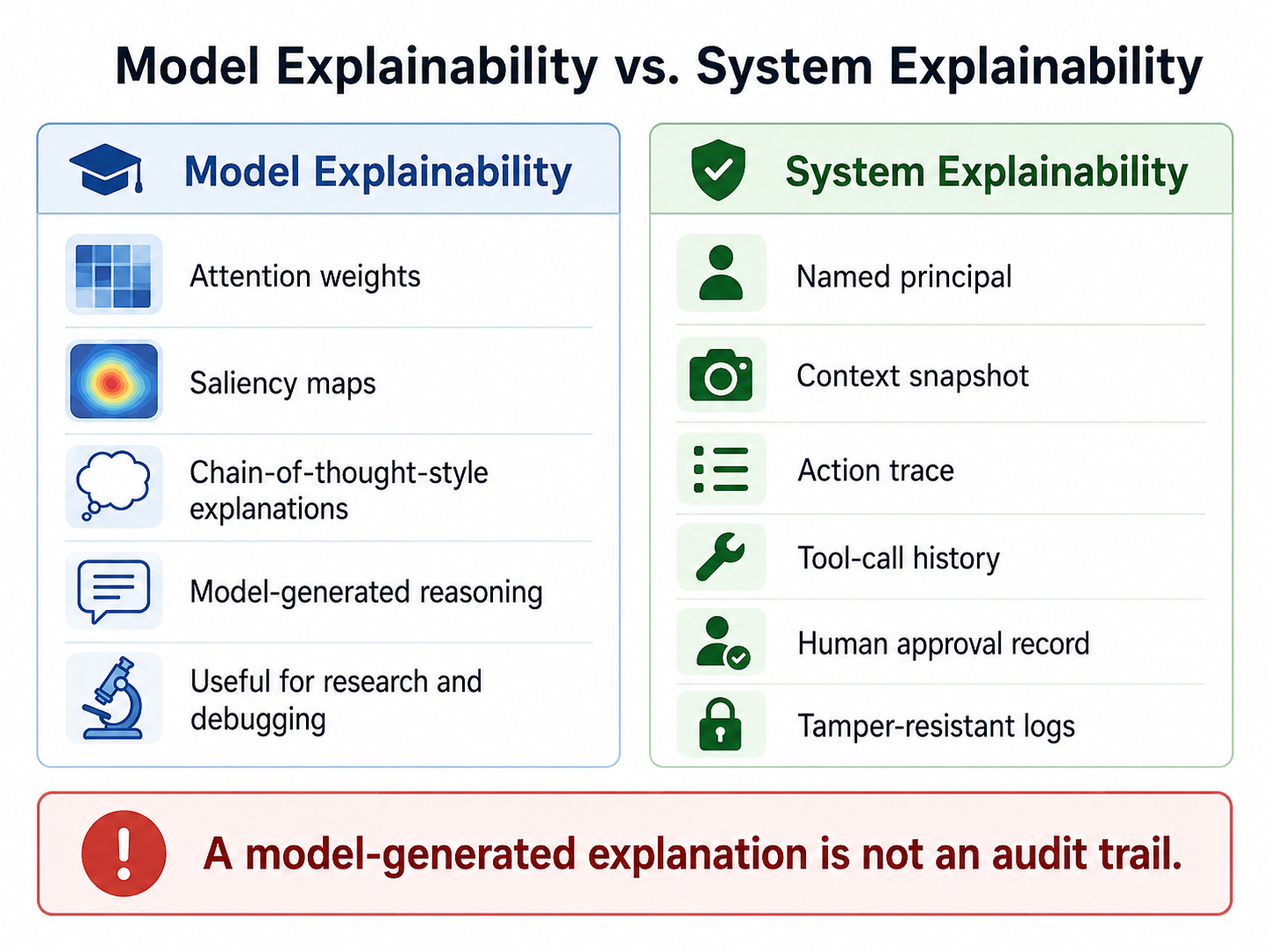
There is a version of AI explainability that the field spent five years debating — attention weights, saliency maps, LIME, SHAP, mechanistic interpretability. That is the question of how the model computes. It is interesting academically and mostly irrelevant to an enterprise audit.
What an auditor asks is different. They are not asking about the model’s internals. They are asking about the system’s behavior:
Who authorized this action?
What information did the agent have when it made this decision?
What did it do, in what order, and when?
Could a human have intervened, and was there a mechanism to do so?
If something went wrong, what exactly happened and can you prove it?
None of these questions are answered by explaining the transformer. They are answered by logs, traces, principal records, and audit trails — and specifically by the absence or presence of those artifacts in your production system.
The goal is practical: can a compliance officer, a regulator, or a board member understand why the agent made a specific decision, backed by evidence?
If answering that question requires a data scientist to open a notebook and reconstruct what happened from scattered logs, the explainability infrastructure is insufficient.
The EU AI Act explicitly requires that evidence of explainability, monitoring, and error recording exist for high-risk systems — not that a smart engineer could theoretically reconstruct it.
That distinction is the whole problem.
Reconstructable is not the same as recorded.
Most agent systems are reconstructable in principle, by someone who knows the codebase, given enough time. None of that is adequate when a regulator gives you 24 hours under NIS2 or 15 days under EU AI Act Article 73.
What Auditors Are Actually Asking
Walk through the five questions an auditor actually needs answered, because each one maps to a concrete engineering requirement your system either satisfies or doesn’t.
“Who authorized this?”
The agent acted.
On whose authority?
With what credential?
Delegated from which human principal?
This is the authorization question from the MCP post applied in a compliance frame: an agent acting with ambient super-user privilege, under no named principal, with no delegation chain, fails this question completely.
The answer requires a principal attached to every action, a delegation record showing which human’s authority was spent, and a credential that scoped what the agent was allowed to do.
“What did it know?”
The agent made a decision based on some set of inputs — retrieved context, tool results, prior turns, injected memory. What exactly was in the context when it decided?
This is the context observability question.
A system that assembled a context window, used it, and discarded it has no answer to this.
The answer requires logging the assembled context at the moment of consequential decisions, with enough fidelity to reconstruct what the agent “knew” when it acted.
“What did it do, and when?”
The full action trace: every tool called, every result returned, every decision point, every external system touched, in order, with timestamps.
Not a summary. Not a log line per request.
A complete, tamper-resistant, structured record of the execution path.
DORA demands forensic evidence within hours. Logs must be digitally signed and timestamped to survive regulatory scrutiny months later.
A system that logs “agent completed task” has not met this bar.
“Could a human have stopped it?”
The EU AI Act requires structured human oversight with clear intervention points, and a control mechanism to stop, correct, or override autonomous operations.
An agent that runs to completion with no human-in-the-loop checkpoint on irreversible actions fails this requirement on its face.
The engineering requirement is checkpoints: explicit pause points at high-consequence junctions where a human can inspect, approve, or abort before the action executes.
“What went wrong and why?”
When the agent fails — and it will fail — can you reconstruct the failure from records?
Which input was wrong, which retrieval missed, which tool misbehaved, which decision was incorrect and at what step?
Without a structured trace, a post-mortem is archaeology.
Under a 15-day incident reporting requirement, archaeology is not a compliance strategy.
The Compliance Landscape Right Now
Five frameworks currently govern AI agents in enterprise deployments, and they converge on the same core requirements with slightly different emphasis.
Knowing which ones apply to you, and what they specifically demand, is the first step to knowing what to build.
EU AI Act (Articles 8–17, 26, 27, 73) — activates August 2, 2026. High-risk AI systems — which include agents making autonomous decisions in credit, employment, healthcare, critical infrastructure, and law enforcement contexts — must maintain technical documentation explaining decision logic and data, automatic event logs for all operations, human oversight mechanisms with intervention capability, and a 15-day serious incident reporting window. Penalties: up to 3% of global annual turnover for non-compliance, 7% for the most serious violations. If you operate in the EU or serve EU users, this applies to you in eleven days.
SOC 2 (AICPA Trust Services Criteria). SOC 2 is not a law but it is the de facto enterprise sales requirement — your largest customers will ask for a Type II report, and agents get scrutinized under the Processing Integrity criterion: is system processing complete, valid, accurate, and timely? Auditors examine access controls, change management, and whether you can demonstrate the agent processed data correctly and completely. An agent that can’t produce a structured record of what it processed and how is a SOC 2 liability.
NIST AI RMF. The US federal standard for AI risk management requires risk identification, measurement, management, and governance throughout the AI lifecycle. In practice, for agents, this means documented risk assessments per use case, monitoring in production, and human oversight that’s more than a checkbox. For any company selling to the US government or regulated US industries, this framework increasingly shapes procurement requirements.
ISO 42001. The emerging international standard for AI management systems requires transparency about AI capabilities and limitations, data provenance, and a continual improvement cycle. The practical requirement: model cards, data lineage documentation, and user-facing disclosures that can be repurposed across audit frameworks. Certification is not yet universal, but enterprise customers increasingly ask for alignment.
GDPR Article 22. If your agent makes automated decisions that significantly affect individuals — loan approvals, job screenings, insurance pricing — Article 22 gives affected persons the right to explanation and human review. The engineering requirement: the system must be able to produce a human-readable explanation of any specific automated decision on request. Not a generic description of how the system works. A specific explanation of this decision for this person at this time.
The frameworks are different documents. The requirements they impose on your architecture are nearly identical.
The Four Things Your Agent Must Prove
Strip the frameworks down and four capabilities cover most of what they require.
1. A named principal on every action. Every tool call, every data access, every external system interaction resolves to a specific human principal whose authority was delegated to the agent for this specific action. Not “the agent.” A person, with a credential, an authorization record, and a scope. The agent proposes; the principal is accountable. This is both the MCP authorization requirement and the EU AI Act accountability requirement, and it’s the same control.
2. A structured, tamper-resistant trace. Every step of every consequential agent run is recorded: inputs received, context assembled, decisions made, tools called, results returned, outputs produced. Structured, not freeform. Tamper-resistant — stored outside the agent’s own reach, digitally signed where required. Queryable — so a compliance officer can reconstruct any run without engineering support. If your logs are scattered across a model provider’s dashboard, a few CloudWatch entries, and someone’s memory, you don’t have an audit trail. You have components of one.
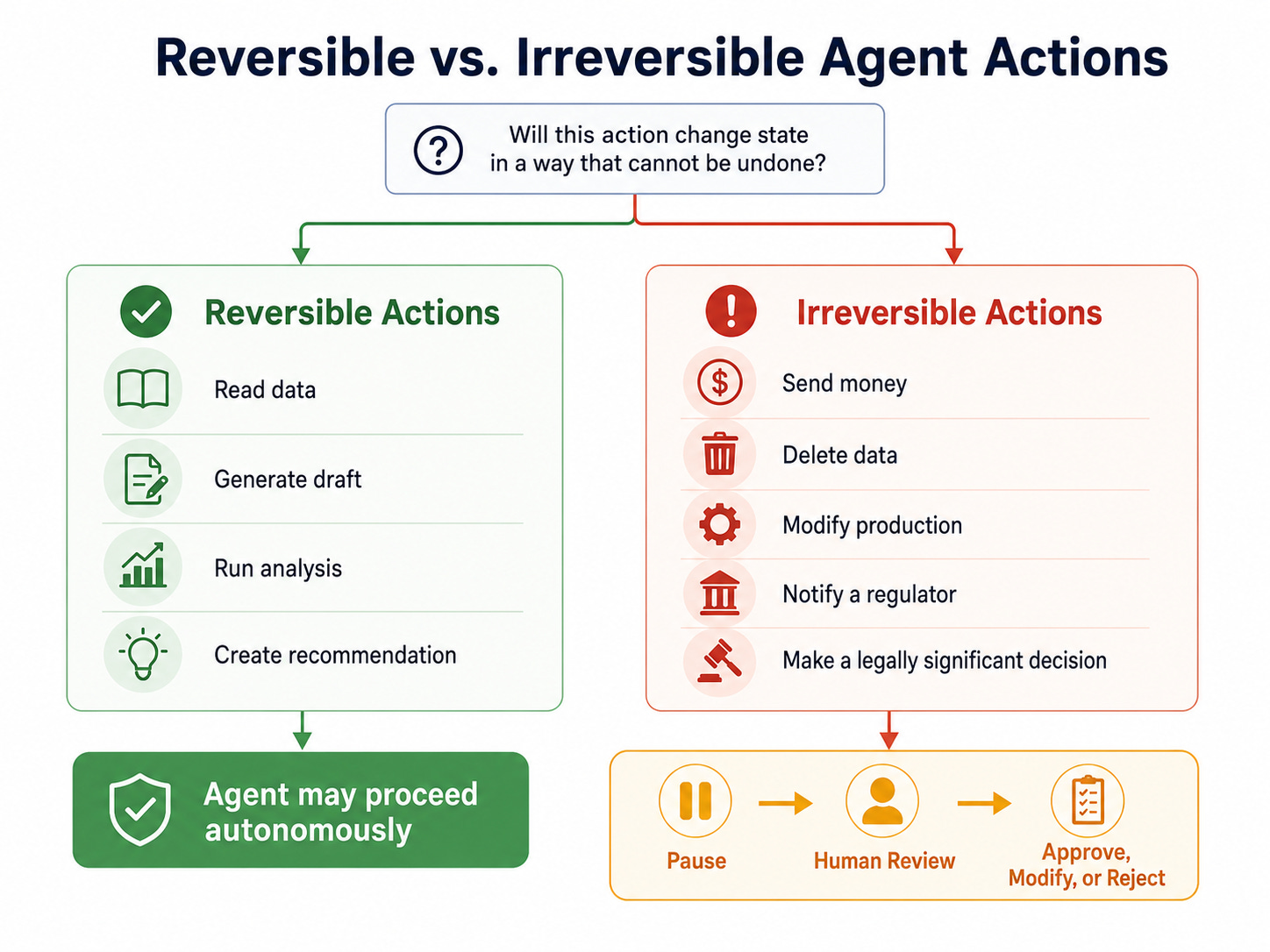
3. Human checkpoints at irreversible junctions. Reversible actions can be autonomous. Irreversible actions — sending money, deleting data, notifying regulators, modifying production systems, taking actions with external legal or financial consequence — require a human to inspect and approve before execution. The checkpoint is not a confirmation dialog bolted on at the end. It is an architectural pause point: the agent builds the proposed action, presents it with its reasoning and evidence, and waits. The human approves, modifies, or aborts. This is what the EU AI Act means by “structured human oversight” and what distinguishes a governed agent from an autonomous one.
4. A reproducible explanation of specific decisions. Given any logged agent action, the system must be able to produce an explanation: what inputs it had, what it retrieved, what options it considered, why it chose what it chose, and what principal authorized it. Not a general description of the system’s design. A specific account of this decision. For GDPR Article 22 cases this is a legal obligation. For every other framework it is the practical standard auditors apply.
Explainability Is an Architecture Problem
Here is the thing that trips most teams: they treat explainability as a model problem and try to solve it with model outputs.
Ask the agent to explain its reasoning. Surface the chain of thought. Print the tool results. These are useful for debugging. They are not audit infrastructure.
The model’s self-report is not an audit trail.
A model saying “I chose this action because of these inputs” is a plausible narrative generated by the same system under audit. It has no independent verification. It can be wrong, fabricated, or selectively omitted.
No serious compliance framework accepts it as a substitute for a structured external record.
Explainability that survives an audit is built outside the model:
At the boundary, where every tool call is intercepted, logged with its principal and scope, and its result is recorded — not by the agent but by the boundary layer the agent cannot modify.
In the trace store, where the assembled context at each consequential step is persisted before the model sees it — so what the agent “knew” is a fact, not a reconstruction.
In the checkpoint system, where proposed irreversible actions are held, presented to a human, and the approval or rejection is recorded alongside the action.
In the principal registry, where the delegation chain from human to agent to tool is maintained and auditable independently of the agent’s own operation.
The model is inside the perimeter. The audit trail is outside it.
Nothing the model writes, reports, or generates can be the primary record of what the model did.
What to Build
The compliance-ready agent architecture is not exotic. It is the authorization boundary from the MCP post, the context observability from the context engineering post, the principal-per-action from the auditing section, and the reversibility-gating from the Fable 5 guide — assembled into a single coherent perimeter.
Concretely:
A principal resolver that attaches a named human identity to every agent session and propagates it to every tool call.
A boundary interceptor that logs every tool invocation with its principal, scope, arguments, result, and timestamp — outside the agent’s process.
A context snapshot store that captures the assembled context at each decision point before the model call — so “what did it know” has a durable answer.
A checkpoint gate for irreversible actions — the agent proposes, execution pauses, a human reviews, the decision is logged whether approved or rejected.
An incident pipeline that can reconstruct the full execution trace of any run within the reporting window your frameworks require.
None of this is in the model.
None of it is generated by the model. All of it is recorded by the system around the model — the same system that was always the real architecture.
The Stakes Sentence
If you are selling to enterprise, you already know the question is coming.
Procurement questionnaires now include AI governance sections. SOC 2 audits now include AI system coverage. Legal reviews now include agent authorization models.
And for any customer in a regulated industry — finance, healthcare, insurance, critical infrastructure, public sector — the question is not “do you have AI governance” in the abstract. It’s the specific, answerable version: show me who authorized that action, what the agent knew when it took it, what it actually did, and how a human could have stopped it.
If your answer requires a sprint to build the infrastructure, you are already behind the customer’s requirement and eleven days behind the regulation’s.
The agent that can explain itself wins the enterprise deal. The one that can’t loses it — or worse, passes the deal and fails the audit.
Build the perimeter.
Record everything.
Name the principal. Gate the irreversible.
The model has never been the hard part. The audit trail always was.