
The Engineer Who Can't Read a Trace Is Already Obsolete
Why trace reading is becoming a core engineering skill for debugging production systems, understanding distributed failures, and staying valuable in the AI-assisted software era.

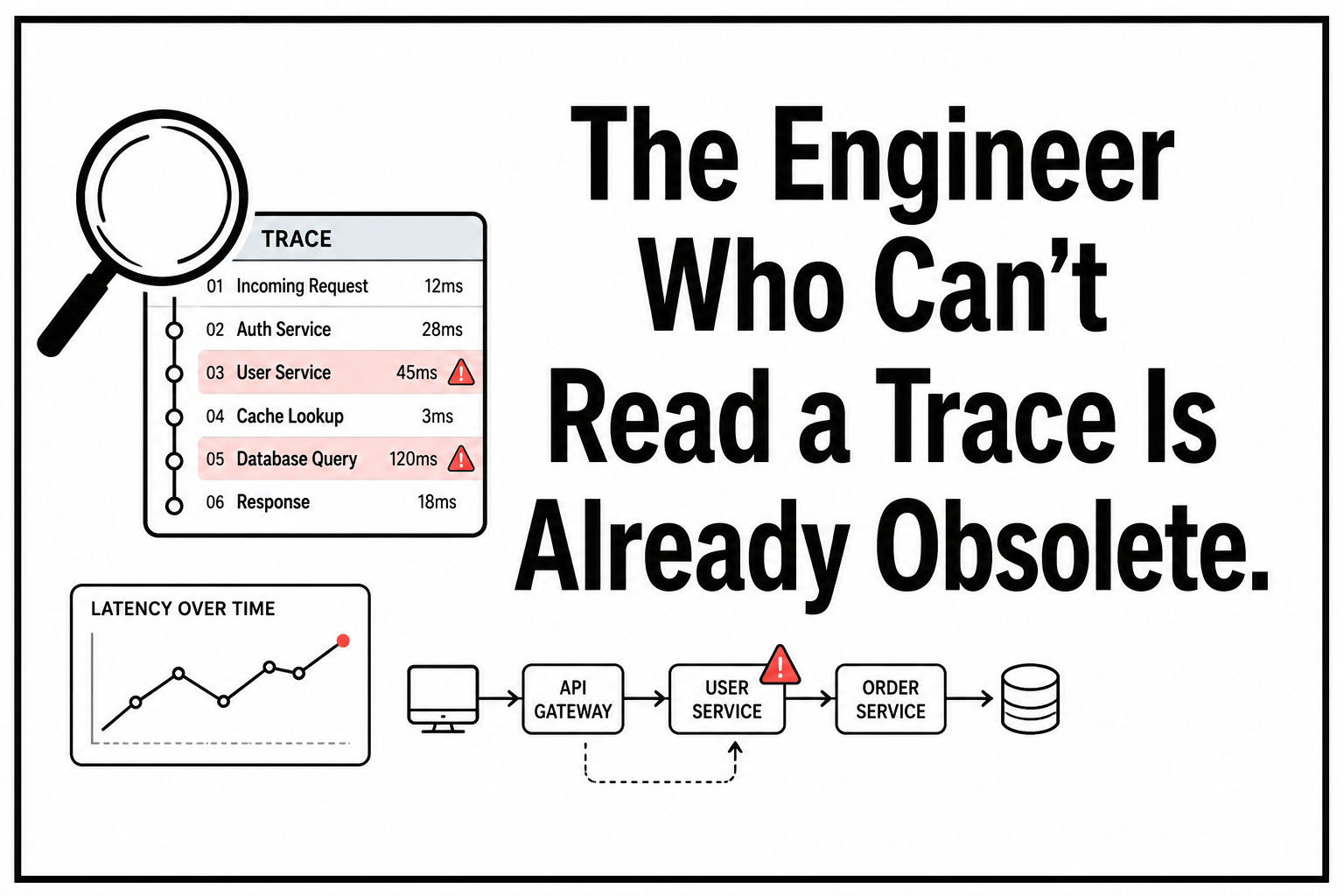
For twenty years, “senior engineer” meant someone who could read a stack trace faster than anyone else in the room.
Give them a null pointer exception, a 500 error, a corrupted state — they’d trace it back through the call stack, find the line, fix it.
That skill was the job. It’s also the first one agentic systems have made irrelevant, and most engineers haven’t noticed yet because the failure doesn’t look like a failure.
It looks like a shrug.
The Trace Changed Shape and Nobody Sent a Memo
A stack trace is deterministic. Line 47 called line 112 called line 9, and the exception tells you exactly where the chain broke. You don’t need judgment to read it. You need patience.
An agent trace is not that. It’s a sequence of retrieved context, tool calls, intermediate reasoning, and a final output — and every one of those steps can be individually reasonable while the composite is wrong. The retrieval pulled the right document but the wrong section.
The tool call succeeded but returned stale data. The model reasoned correctly over a context window that silently dropped the constraint that mattered. None of these throw an exception.
All of them produce a plausible, confident, incorrect answer.
The engineers still treating this like log-reading are the ones asking “what error did it throw?”
The ones staying ahead are asking “at which step did the belief diverge from the fact?”
That second question doesn’t have a line number. It has a trace, and reading it is a different skill than the one you spent a career building.
Why This Is a Career Problem, Not a Tooling Problem
Here’s the part that should actually worry you: this isn’t a skills gap you close with a new framework or a better observability dashboard.
Tooling can show you the trace.
Tooling cannot tell you which step in a five-hop reasoning chain introduced the hallucination, because that requires understanding what the model should have concluded at each hop — which requires you to hold the domain logic in your head well enough to spot the moment it went sideways.
That’s not a junior skill. It’s not something you delegate to an eval framework, either — evals tell you that something broke, in aggregate, after the fact. They don’t tell you where, in this specific run, for this specific user, right now. When production is on fire and a customer is asking why the agent told them something false, “the eval suite is green” is not an answer anyone accepts.
This is why the gap is opening specifically at the senior level. Junior engineers were never expected to debug blind — they escalate.
Staff and principal engineers who built their authority on being the fastest trace-reader in the building are discovering that the skill doesn’t transfer, and there’s no obvious next rung to climb to replace it.
The bricklaying skill they mastered has no probabilistic equivalent they were ever taught.
What Reading an Agent Trace Actually Requires
Three things, and none of them are “learn a new tool”:
Reconstructing the belief state. At every step, what did the system think was true, and why? You have to hold the running context — not the final output — as the object of your attention. Most engineers instinctively debug backward from the wrong answer. That’s the deterministic habit. It fails here, because the wrong answer was usually produced by correct reasoning over wrong premises upstream.
Distinguishing retrieval failure from reasoning failure. These look identical in the output and are opposite problems. If the model reasoned well over bad context, the fix is in your retrieval layer. If it reasoned poorly over good context, the fix is in your prompt or your model choice. Conflate them and you’ll spend a sprint hardening the wrong system while the actual failure mode ships again next week.
Knowing what “good” looked like before you saw the trace. You can’t spot a divergence from correct behavior if you don’t have a strong prior about what correct behavior is. This is domain expertise, not engineering skill — which is exactly why it can’t be outsourced to a smarter model or a better observability vendor. The trace only means something to someone who already knows the shape of the right answer.
The Audit Is Coming Whether You’re Ready or Not
Regulators, enterprise customers, and internal risk teams are converging on the same question for every agentic system in production: when this went wrong, who can explain why?
“The model hallucinated” is not going to satisfy anyone holding a compliance checklist. Neither is a dashboard full of green evals that didn’t catch the incident in question.
The only acceptable answer is a person who can open the trace, walk through it step by step, and point to the exact moment belief and fact split apart.
That person is your most valuable engineer for the next decade. Not because they can prompt well, not because they know the latest framework, but because they can do for probabilistic systems what the best debuggers did for deterministic ones — hold a causal chain in their head and find the break.
If that’s not a skill you’re actively building right now, in production, on your own systems, the obsolescence isn’t coming. It’s already priced in. You just haven’t been told the number yet.