
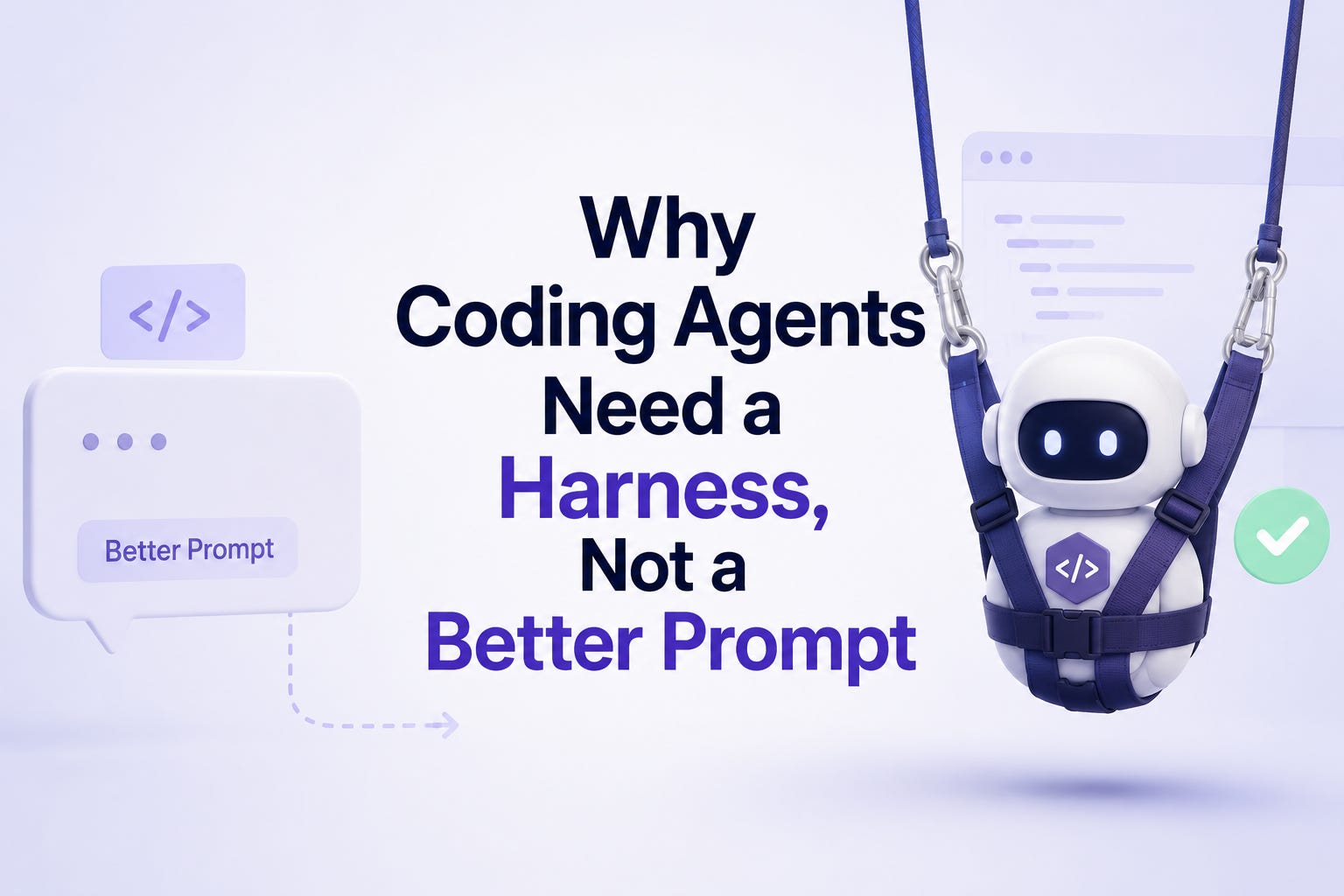
Why Coding Agents Need a Harness, Not a Better Prompt
Stop prompt engineering. Start designing the system that makes the model succeed.

What This Blog Covers
Why prompts stop scaling
The rise of harness engineering
Repository context selection
Sandboxes and tool permissions
Tests as execution guardrails
Evidence-based task completion
A familiar pattern is emerging across engineering teams.
A coding agent struggles with a task. The pull request is incomplete, the implementation misses edge cases, or the generated code breaks existing tests. The immediate reaction is almost always the same.
“Let’s improve the prompt.”
More examples get added. Instructions become longer. The system message expands from a few paragraphs into several pages. Eventually the prompt starts looking less like a request and more like a legal contract.
The results improve slightly, but not enough.
The team tweaks the prompt again.
Then again.
Then again.
This is the modern version of performance tuning by superstition. It assumes the model is the primary variable controlling outcomes. Increasingly, the evidence suggests something different.
The highest-performing coding agents are not succeeding because they have dramatically better prompts. They are succeeding because they operate inside dramatically better environments.
The industry is slowly rediscovering a lesson that software engineering learned decades ago.
Systems outperform components.
A database is not valuable because of its storage engine alone. A web application is not valuable because of its HTTP server alone. The surrounding architecture determines whether the individual component succeeds or fails.
Coding agents are no different.
The future belongs to the harness.
The Prompt-Centric Trap
Most discussions about coding agents focus on models and prompts. The assumption is that better outcomes come from better instructions.
If the agent produces poor code, the prompt must be insufficient.
That explanation feels intuitive because prompts are visible. Engineers can read them, modify them, and experiment with them directly. The harness operating around the model is often invisible.
Unfortunately, visibility and importance are not the same thing.
Imagine asking a new engineer to fix a bug inside a large monorepo. You give them no documentation, no access to tests, no repository search tools, and no way to execute code locally. Even a strong engineer would struggle under those conditions.
Now imagine giving the same engineer access to documentation, test suites, debugging tools, repository search, and a safe development environment. Their performance improves immediately without changing anything about the engineer.
The same principle applies to coding agents.
The prompt matters. The environment matters more.
The Emergence of Harness Engineering
A new idea has started appearing across the industry.
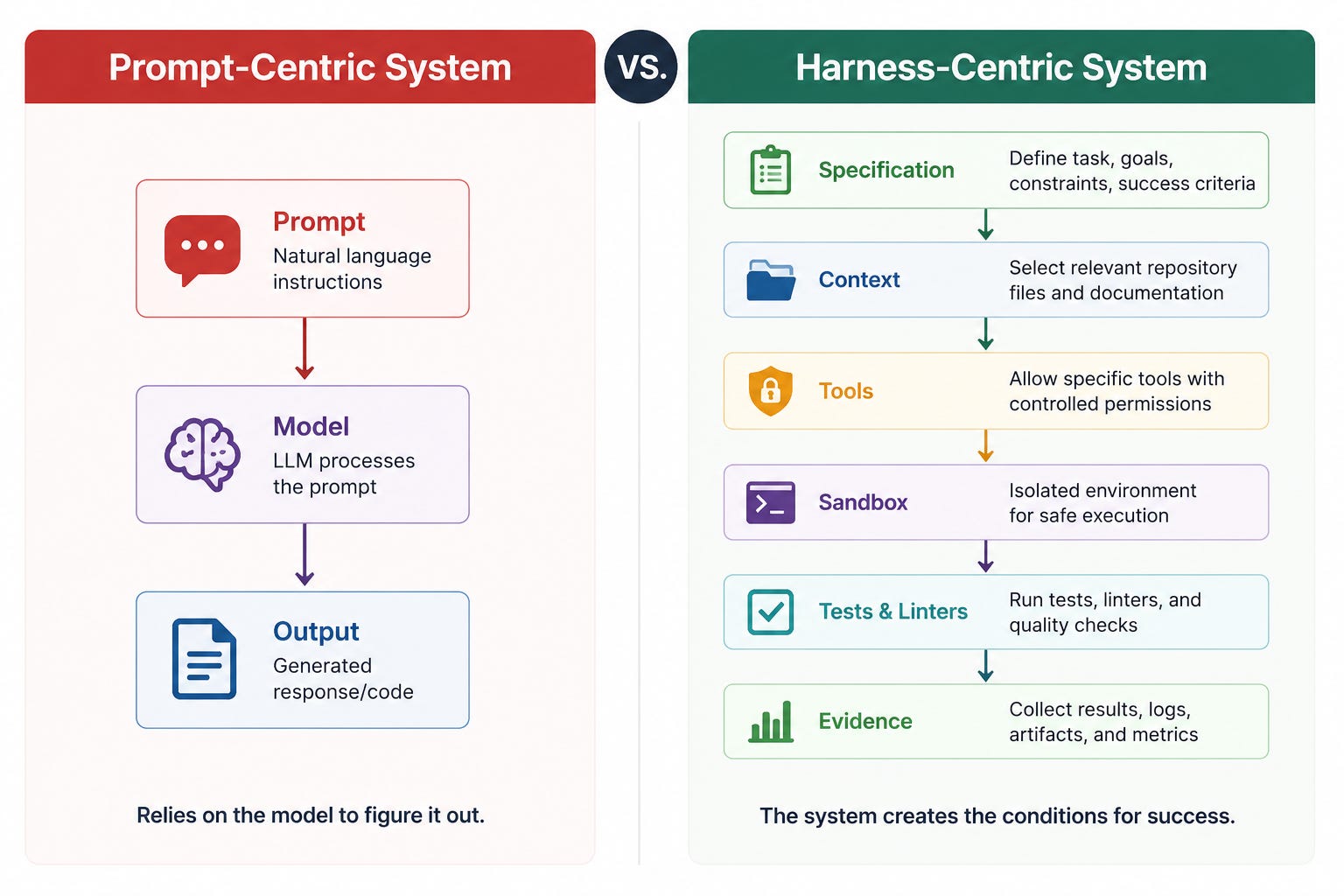
Coding-agent performance is increasingly being viewed as the outcome of a complete model-harness-environment system rather than the model itself. The focus shifts away from what the model knows and toward what the surrounding infrastructure enables.
This perspective changes the optimization target.
Instead of asking:
“How do we write a better prompt?”
Teams begin asking:
“How do we create a better operating environment?”
That question is much closer to traditional system design.
A coding agent is not simply generating tokens. It is operating inside a workflow that includes context selection, tool access, execution environments, validation systems, and human review processes.
Every one of those layers influences performance.
In many cases, they influence performance more than the prompt itself.
Task Specification Is the New Requirements Document
The hardest part of software engineering has never been writing code. The hardest part has always been understanding what should be built.
Coding agents inherit the same problem.
A vague task produces vague outcomes.
An ambiguous requirement creates ambiguity throughout the entire workflow. The model cannot reliably solve a problem that has not been clearly defined.
This is why task specification has become one of the most important components of modern agent systems.
A strong task specification defines objectives, constraints, expected behavior, success criteria, and known edge cases. It reduces interpretation and increases predictability.
Notice how similar this sounds to traditional engineering.
The challenge is not generating syntax. The challenge is creating a precise description of the desired outcome.
The prompt is only one part of that process.
The specification is the foundation.
Repository Context Is Becoming a Retrieval Problem
Most software projects contain far more information than a model can effectively consume at once. Large repositories contain thousands of files, years of history, architectural decisions, test suites, and hidden assumptions.
The agent cannot read everything.
This transforms coding into a retrieval problem.
The question is no longer whether the model is intelligent enough to solve the task. The question becomes whether the model has access to the information required to solve the task.
Poor context selection creates poor outcomes regardless of model quality. Missing files, incomplete dependency graphs, and absent documentation often explain failures more accurately than prompt quality.
This should sound familiar.
The industry spent years learning that retrieval quality determines RAG quality. Coding agents are now encountering the same reality inside repositories.
Context is becoming infrastructure.
The best coding agents are not necessarily the ones with the largest context windows. They are the ones receiving the right context at the right time.
Tool Permissions Define the Agent’s Reality
A coding agent can only act within the boundaries of its environment.
If the agent cannot search the repository, it will guess. If it cannot inspect logs, it will infer. If it cannot execute commands, it will reason in the dark.
Every missing capability forces the model toward speculation.
This creates a trade-off.
Expanding tool permissions increases capability, but it also increases risk. A highly capable coding agent can modify files, execute commands, install dependencies, and change infrastructure. Those same abilities create opportunities for mistakes.
The solution is not unlimited access.
The solution is carefully scoped access.
Good harnesses treat permissions the same way operating systems treat permissions. Access is granted deliberately, monitored continuously, and restricted whenever possible.
This is security engineering applied to agent systems.
Sandboxed Execution Changes Everything
One of the biggest limitations of early coding assistants was that they could only reason about code. They could not execute it.
This forced the model to predict outcomes without observing reality.
A sandbox changes the equation.
Instead of imagining whether code works, the agent can run the code, inspect errors, execute tests, and iterate based on actual feedback. The workflow becomes grounded in evidence rather than speculation.
This dramatically improves reliability.
More importantly, it changes the role of the model.
The model stops acting like an oracle and starts acting like an engineer. It forms hypotheses, runs experiments, observes outcomes, and adjusts its approach.
That loop is where much of the recent progress in coding agents originates.
Not from bigger prompts.
From better environments.
Tests Are Becoming the Real Prompt
Many teams still treat tests as a validation mechanism that runs after development is complete. Coding agents reveal a different perspective.
Tests are increasingly becoming a guidance mechanism.
A well-designed test suite tells the agent exactly what success looks like. It provides immediate feedback whenever behavior deviates from expectations. It transforms correctness from a subjective judgment into an observable signal.
This is incredibly valuable because language is inherently ambiguous.
Tests are not.
The model may misunderstand a requirement. It cannot easily misunderstand a failing assertion.
In practice, the strongest coding-agent workflows often rely more heavily on tests than prompts. The prompt describes the objective. The tests define reality.
That distinction matters.
Failure Attribution Is the Missing Layer
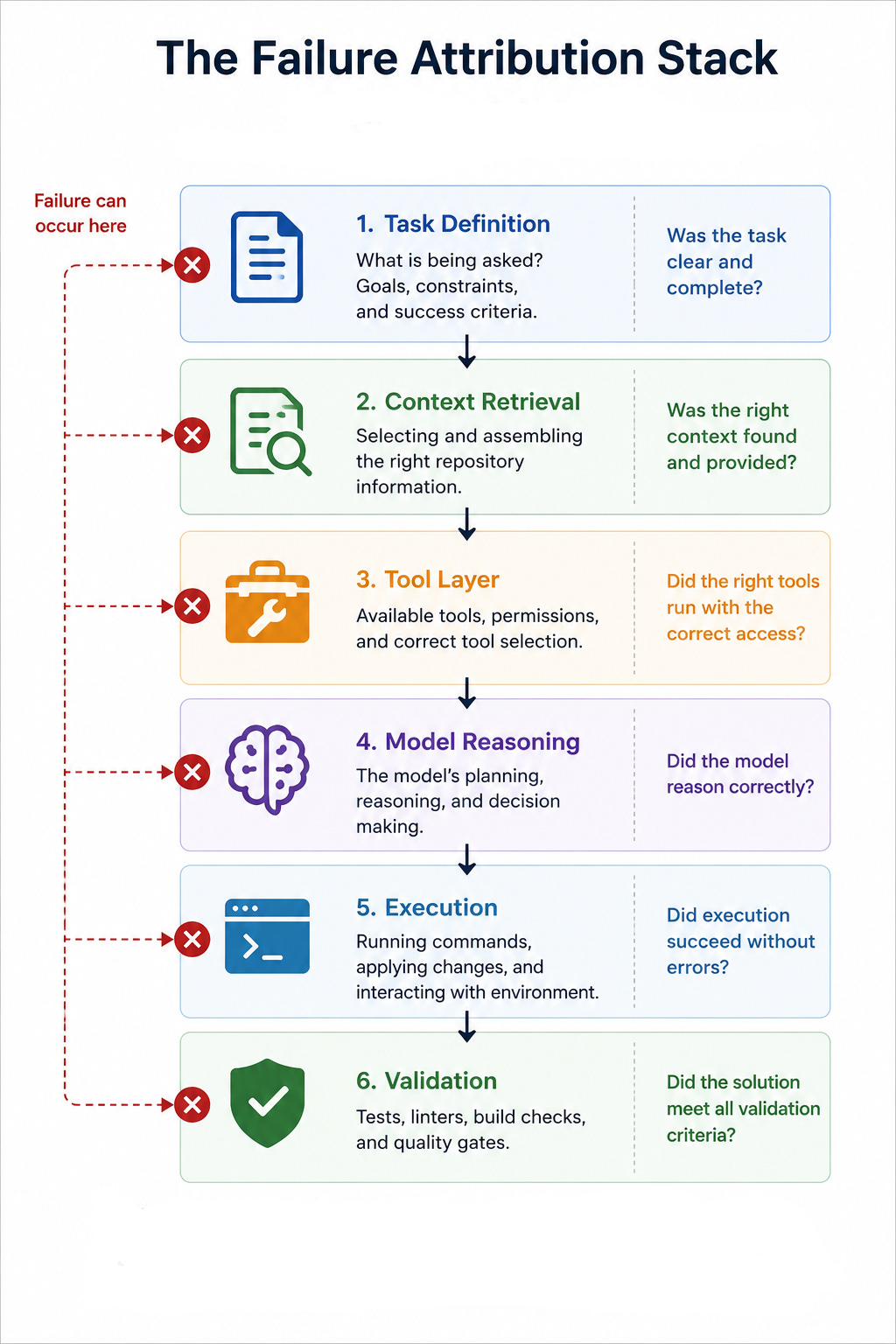
When a coding agent fails, teams often struggle to explain why.
Was the task unclear?
Was the repository context incomplete?
Did the retrieval system surface the wrong files?
Was the model reasoning incorrectly?
Did a tool malfunction?
Without failure attribution, improvement becomes guesswork.
Engineers begin modifying prompts because prompts are visible, even when the root cause exists elsewhere in the system.
A mature harness treats failures as observable events. Every failure should be traceable to a specific layer in the workflow.
The goal is not merely identifying that something broke.
The goal is understanding what broke.
Observability transformed distributed systems.
It will do the same for coding agents.
Completion Evidence Matters More Than Confidence
One of the most dangerous properties of language models is that they can sound finished before they are actually finished.
This creates a reliability problem.
The agent claims success. The implementation compiles. The pull request appears complete. Hidden defects remain undiscovered.
Strong harnesses solve this problem through evidence.
A task is not complete because the model says it is complete. A task is complete because tests passed, linters succeeded, build steps finished, and validation checks produced the expected results.
Evidence replaces confidence.
This principle appears repeatedly throughout engineering. Databases use transactions instead of trust. Distributed systems use acknowledgments instead of assumptions.
Coding agents require the same discipline.
The system should verify completion rather than believe it.
Human Intervention Is a Feature, Not a Failure
There is a persistent fantasy that coding agents will eventually eliminate human involvement entirely.
That may be possible for some narrow workflows. It is unlikely to be the dominant pattern for important software systems.
The most successful engineering organizations rarely remove humans from critical processes. Instead, they create escalation paths for situations where automation becomes uncertain.
Coding agents should follow the same model.
Human intervention records provide accountability, context, and learning opportunities. They create a history of decisions that can later improve the system.
More importantly, they recognize a simple reality.
Not every problem should be solved autonomously.
Some problems should be escalated.
The strongest systems know the difference.
The Real Competitive Advantage
The industry is currently obsessed with model comparisons.
Which model writes better code? Which model scores higher on benchmarks? Which model solves more tasks?
Those questions matter.
They are also becoming less important.
As models converge, the surrounding system becomes the primary source of differentiation. The quality of the harness determines what information the model sees, what tools it can access, what feedback it receives, and how its outputs are validated.
The harness shapes the reality in which the model operates.
This is the same transition every technology platform eventually experiences. Early competition revolves around components. Mature competition revolves around systems.
Coding agents are entering the systems phase.
The organizations that understand this will stop chasing prompts and start designing environments.
The End of the Prompt Era
Prompt engineering is not disappearing.
It is becoming infrastructure.
The same thing happened to databases, networking, and cloud provisioning. Technologies that once felt like competitive advantages eventually became foundational building blocks.
The next frontier is harness engineering.
The winning coding agents will not be defined by a clever prompt hidden inside a system message. They will be defined by task specifications, retrieval systems, execution environments, validation layers, observability pipelines, and escalation workflows working together as a coherent whole.
The model remains important.
It is simply no longer the whole story.
The future of coding agents belongs to the complete model-harness-environment system.
That is a system design problem.
Not a prompting problem.