
Why Senior Engineers Are Losing the Middle Ground
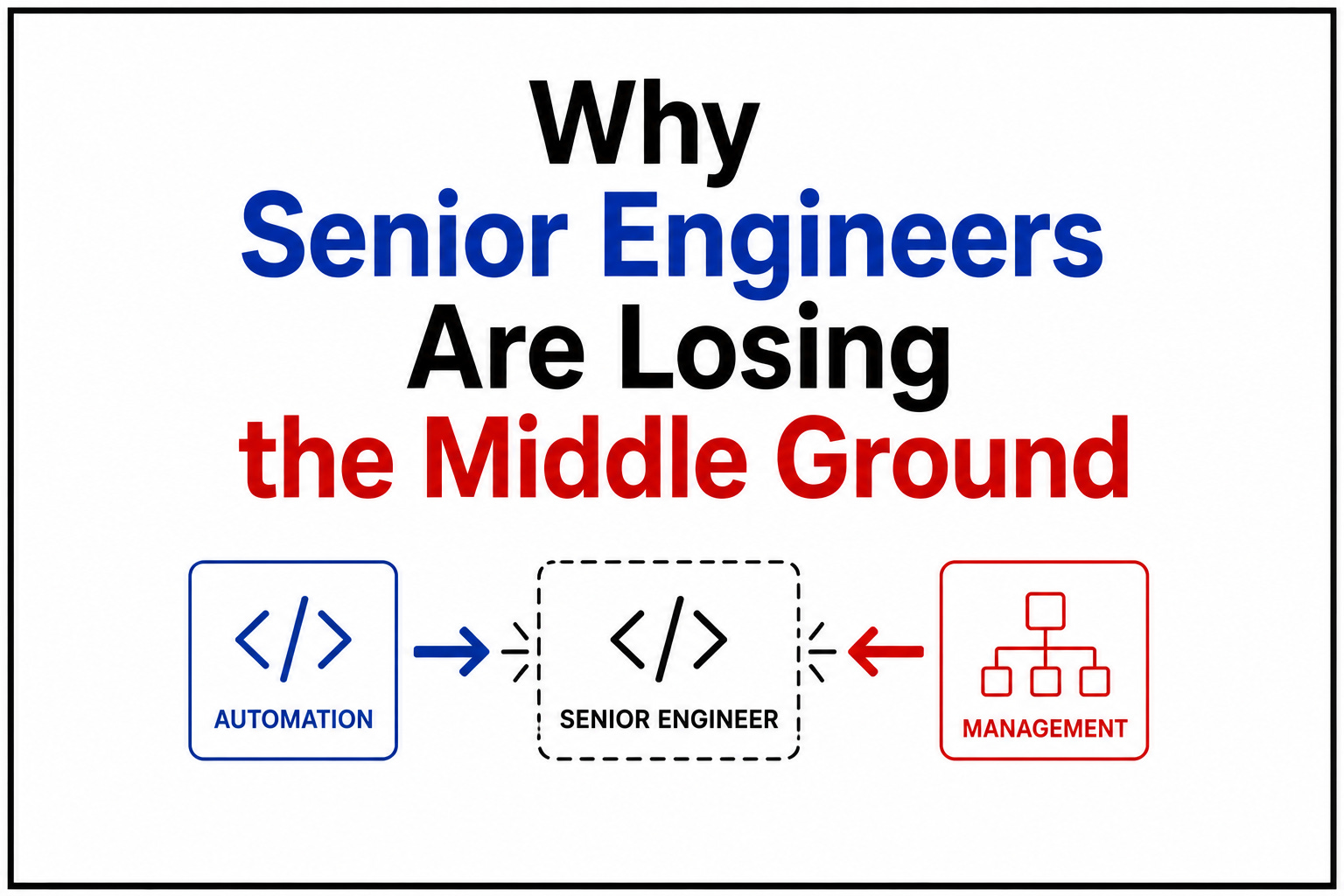
The bottom of the career ladder is gone. The top is being redefined. The middle (the place most senior engineers actually live) is under pressure from both directions simultaneously.

If you are a software engineer, let’s talk about what’s actually happening to your job.
Not the abstract version. Not “AI will change everything” hand-waving or “engineers will always be needed” reassurance.
The specific, data-grounded, uncomfortable version of what is happening to the senior software engineer role in 2026, right now, while everyone is busy debating whether AGI is six months away.
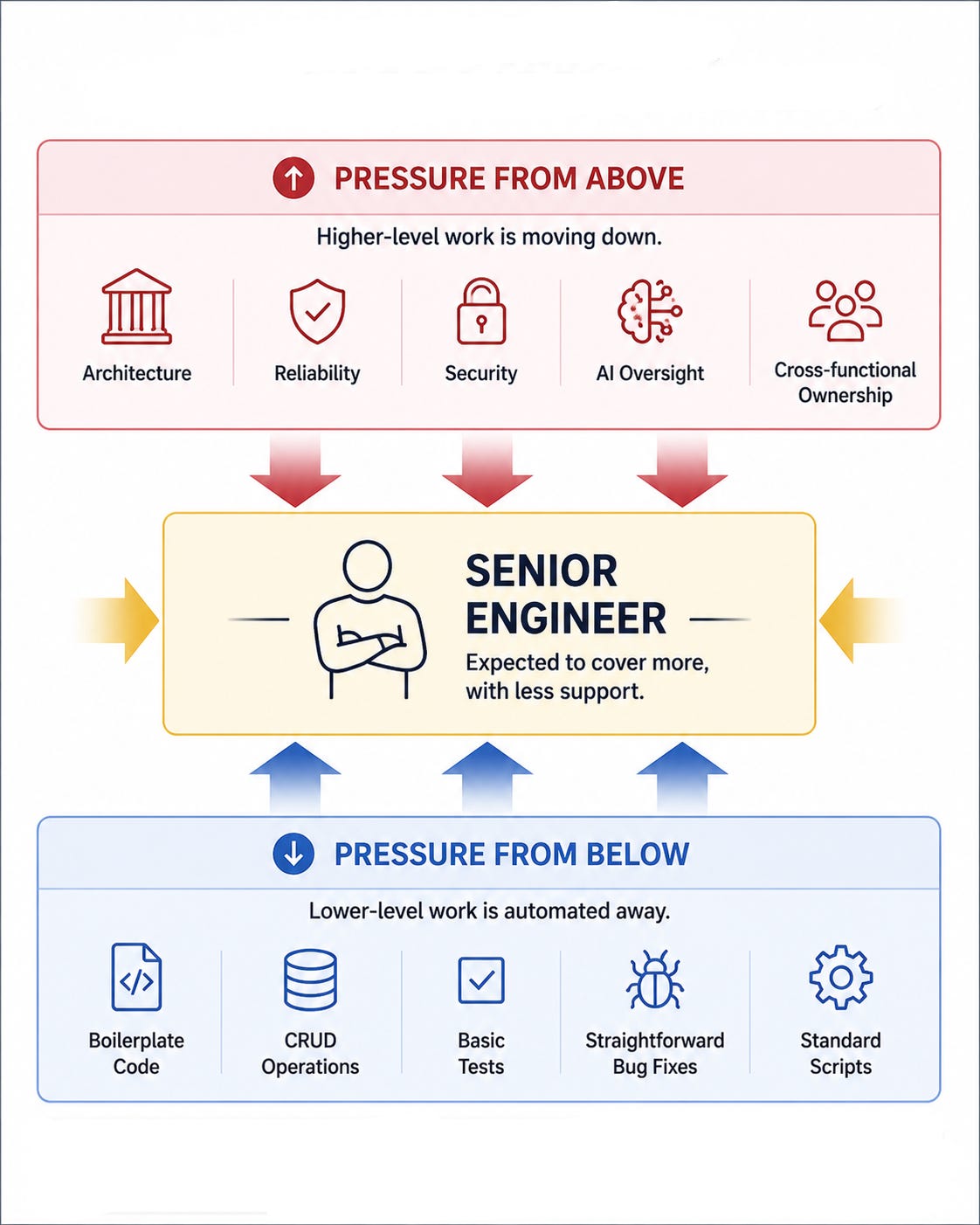
Here it is: you are being hollowed out from both ends.
From below, the junior layer is collapsing.
The work that used to flow down to a team of three or five juniors — the CRUD endpoints, the boilerplate, the straightforward bug fixes, the standard test scripts — is now being done by AI tools, faster than any junior could do it, at a fraction of the cost.
Stanford’s 2026 AI Index found that employment among 22-to-25-year-old software developers fell nearly 20% from its late 2022 peak.
Not during a recession.
Not because the industry contracted.
During the biggest AI investment surge in history.
The bottom of the pipeline didn’t just slow. It collapsed.
From above, the definition of what “senior” means is being raised.
Architect-level judgment — system design, trade-off reasoning, cross-functional technical leadership, probabilistic-system reliability — is now the baseline expectation for anyone who wants to remain irreplaceable.
The work the principal engineers and distinguished engineers used to own exclusively is flowing down to you, because the layer above is thinning too, and someone has to own the hard problems.
You are being asked to do both jobs. You have lost the help you used to have. And the tools you’re using to compensate are the same ones applying the pressure.
This is what hollowing out looks like. Not a single catastrophic event.
A slow, structural compression from both directions until the middle — the place you actually work — has less room in it than it used to.
The Bottom Is Already Gone
Start with the data because it’s worse than most people have internalized.
A 22-year-old developer entering the market today is entering a market that has eliminated 20% of the positions that existed for people like them two years ago. Junior developer job postings saw a 49% decline between 2022 and 2025.
The companies that used to hire three or four juniors per senior are now hiring leaner — in some cases no juniors at all.
The entire apprenticeship model that turned raw graduates into working engineers, and working engineers into seniors, is breaking down.
The AWS CEO called the strategy of simply eliminating the junior layer “one of the dumbest things he’d ever heard” — warning about a catastrophic skills gap in the next decade.
He’s right about the long-term.
But the short-term is already here, and the short-term is: the junior work isn’t gone, it’s been redistributed upward.
When an AI agent generates the boilerplate, who reviews it?
You.
When the scaffold comes back with a subtle race condition buried in generated code, who finds it?
You.
When the junior who would have spent two days understanding the codebase before writing the wrong test isn’t hired, who writes the right test?
You.
The work didn’t disappear.
The human who used to do it did.
A senior developer equipped with AI tools can now produce what previously required multiple team members. That productivity gain has translated directly into smaller teams. And smaller teams mean you own more of the pyramid — not just the top of it.
The Top Is Moving Up
At the same time, the expectation for what constitutes valuable senior work has shifted upward.
The things AI still genuinely cannot do — as of 2026, based on where models actually perform versus where they claim to — are concentrated in a specific set of skills.
Distributed systems design under real constraints.
Reliability engineering for probabilistic, non-deterministic components.
Security architecture for agentic systems.
The ability to evaluate whether generated code is not just correct but safe, maintainable, and appropriately paranoid about the edge cases the generator didn’t think about.
The judgment to know when a 70% solution is good enough and when it will burn the company down in six months.
That is the work the market is pricing up. Roles requiring system design, architecture, and AI oversight are growing.
Senior engineers fluent in AI tooling earn measurably more than those who aren’t.
The skills gap that’s creating value is not at the bottom — it’s at the top of the stack, in the territory that used to belong to principal and staff engineers, which is now the survival bar for senior.
In other words, what “senior” meant in 2022 — write clean code, understand the system, mentor the juniors, make reasonable architectural choices — is not what “senior” means in 2026.
The baseline has moved.
The work that used to earn you a senior title is increasingly the work that gets automated or delegated to tools.
The work that now defines senior is the work that used to define the role above it.
Most senior engineers are aware of this shift in the abstract. Very few have explicitly reckoned with its career implications.
The Compression Problem Nobody Is Talking About
Here is the part that gets almost no attention: the compression itself is the threat, not either end individually.
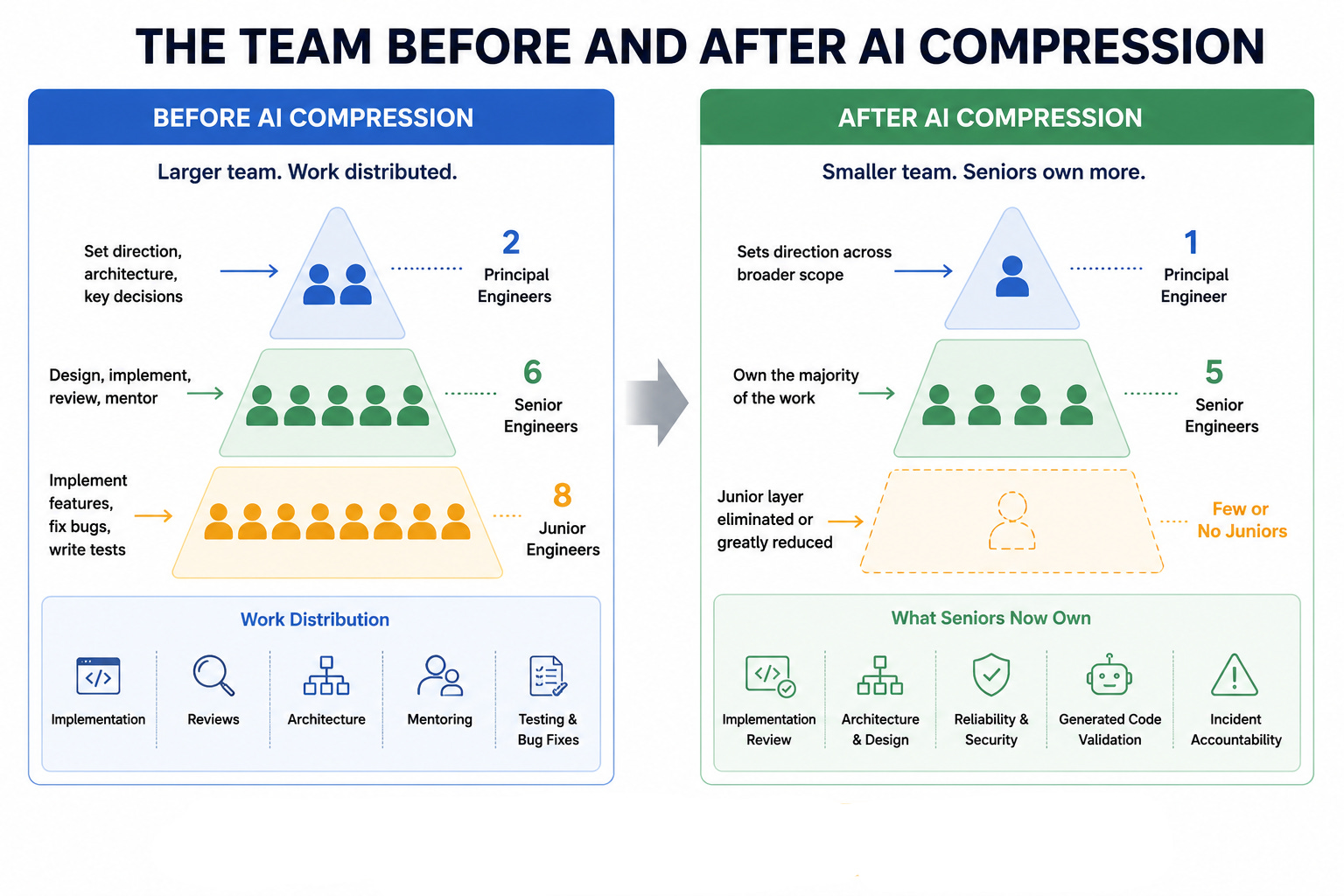
Imagine a team that used to be: two principal engineers setting direction, six senior engineers implementing with help from eight juniors.
Now imagine: the junior layer gone, one principal engineer with a broader scope, and five senior engineers being asked to cover the territory the whole former team covered.
Not because the product got simpler. Because the productivity tools got faster, the headcount math changed, and the org chart got flatter.
Those five senior engineers are now doing something fundamentally different from what the six used to do. They’re reviewing AI-generated code they didn’t write and don’t intimately know. They’re making architectural decisions that used to be kicked upward.
They’re owning the reliability of systems that have probabilistic components whose failure modes are novel.
They’re context-switching between “be a very fast reviewer of generated code” and “think deeply about whether this system design is safe.”
Both of those are real jobs.
Neither of them is easy.
They are not the same job. And doing them simultaneously, without the support structure that used to exist in both directions, is the actual lived experience of being a senior engineer in 2026 — and why the profession feels harder even as the individual coding tasks get easier.
The AI-generated code is faster.
The system is more complex.
The team is smaller.
The accountability surface is larger.
Those four facts together are the hollowing.
The Skills That Don’t Compress
The question worth answering: given all of this, what is actually defensible?
Not “prompt engineering” as a catch-all. That answer is too convenient and too unstable — prompting skill without deep domain knowledge is itself compressible.
The skills that don’t compress are the ones that require the thing AI genuinely doesn’t have: accumulated judgment about systems you’ve seen fail.
You know that the query that looks fine in development will annihilate the index under production load, because you’ve seen it happen.
You know that the distributed state management pattern the AI suggested is eventually consistent in a way that will produce corrupted user data on the day your largest customer signs.
You know that the security model looks plausible on paper and has a class of injection attack that won’t show up in a code review.
You know because you were there when it happened.
That knowledge — the visceral, scar-tissue kind — is not in the training data. It can’t be. It’s specific to your systems, your failures, your customers, your incidents.
An AI can tell you abstractly about race conditions. It cannot tell you about the specific race condition that lives in your specific combination of Postgres advisory locks, your specific background job queue, and your specific use of Redis Pub/Sub, which you’ve seen produce a corrupted state exactly once, on a Tuesday, at high write load.
That specificity is what you sell. Which is why the engineers who are most threatened are the ones whose knowledge is most general — because general knowledge is closest to what the models have. And the engineers who are most defensible are the ones whose knowledge is most specific to systems that have been through real production failure.
The implication for your career: stop widening and start deepening.
The safe move in 2022 was to broaden your stack, pick up a new framework, become T-shaped across multiple technologies.
The safe move in 2026 is to own the failure modes of systems in your domain with a specificity that no model can replicate.
Know one thing so well that “the AI can do it” is never the complete sentence.
What You Actually Have to Become
The other side of this — the affirmative version — is what this publication has been arguing from the beginning.
The unit of work is the system, not the function.
The General Contractor, not the bricklayer.
The person who designs the wall and decides whether it will stand, not the person who places the next brick.
That framing is now not a philosophical position about the future of the craft. It is a survival requirement, with a measurable deadline.
The senior engineer who can only implement — even very well, even quickly — is occupying territory that is being compressed from below.
The senior engineer who can specify, evaluate, architect, and take accountability for the reliability of probabilistic systems is occupying territory that is expanding, because that territory is where the value is going and where the tools cannot follow yet.
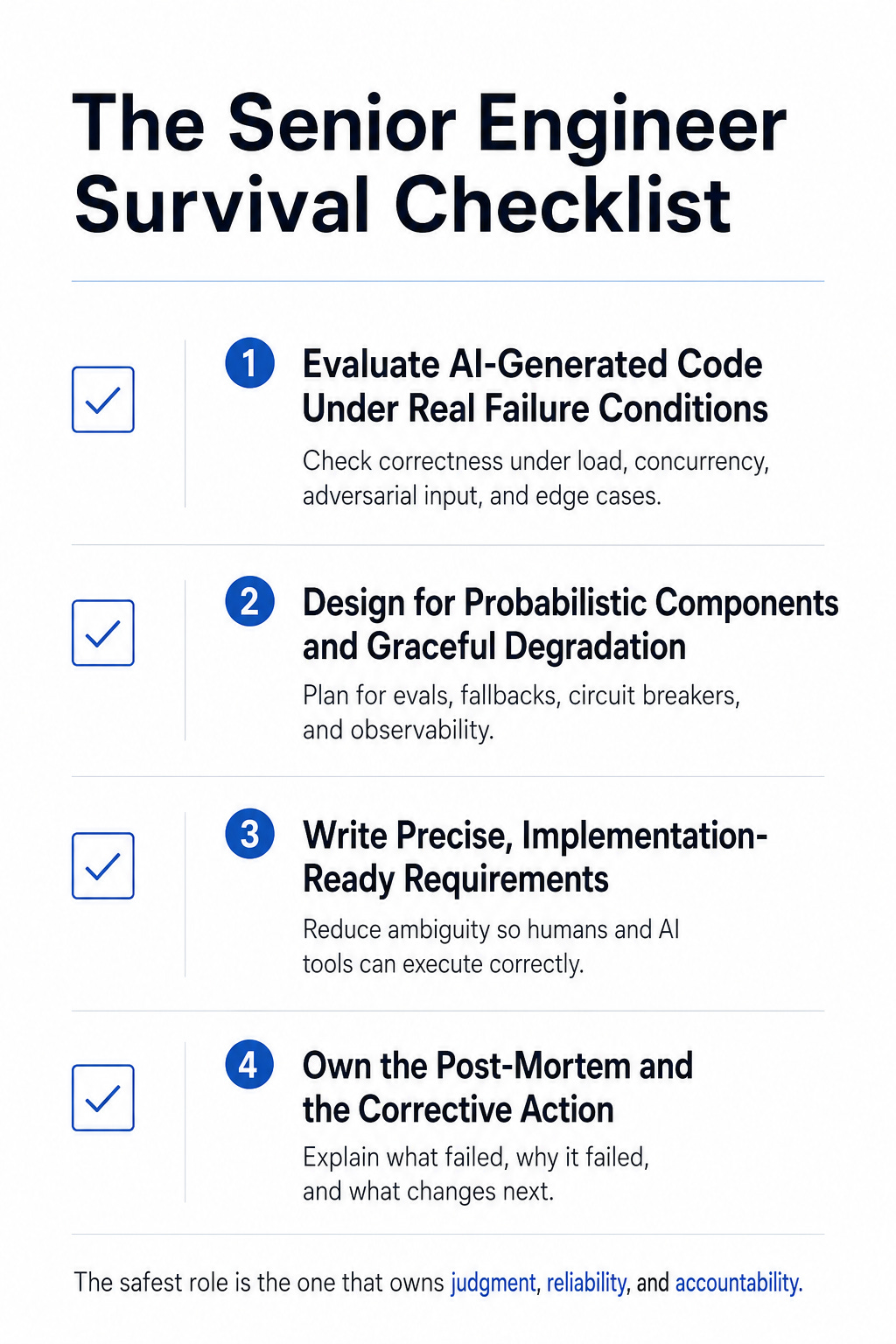
There is a checklist embedded in that, and it’s worth running honestly:
Can you evaluate AI-generated code for the failure modes the generator doesn’t know about?
Not whether it compiles. Whether it’s correct under load, adversarial input, concurrent access, and the specific edge cases your system produces.
Can you design systems that assume their components will fail probabilistically?
Not just fault tolerance in the abstract. Evals, fallbacks, circuit breakers, graceful degradation, and the observability that tells you when it’s happening.
Can you specify what you want precisely enough that a machine can implement it?
Ambiguity is the enemy of both AI agents and junior engineers. The senior engineer who can write requirements so precise they leave no room for misinterpretation is doing the work that cannot be automated.
Can you own the accountability?
When the AI-assisted system fails — and it will fail — the General Contractor is accountable, not the tools. The engineer who can stand in the post-mortem and say “here is what I designed, here is why it failed, here is what I’m changing” is doing a job that has no AI equivalent.
If the answer to most of those is yes, you are on the right side of the compression.
If the answer to most of them is “I implement what’s specified,” the pressure you’re feeling is structural, and it will increase.
The Career Move Nobody Wants to Make
The uncomfortable conclusion, and the reason I wrote “senior” rather than “junior” in this title:
The engineers who are at immediate risk are not the ones whose title says junior. They’re the ones whose work is junior, regardless of what their title says.
The six-year engineer who still primarily implements — who receives a spec and produces code and considers the job done — is in the compressed middle, whether or not their company has noticed yet.
The title caught up. The job didn’t.
The career move nobody wants to make is to look honestly at what you actually do in a given week and ask: what percentage of it could be described as “receiving a spec and producing an implementation”?
Because that percentage — whatever it is — is the percentage of your current role that is under compression.
And the answer to compression is not to implement faster.
The tools already implement faster than you.
The answer is to own the layer that decides what gets implemented, whether it was implemented correctly, and whether it will hold.
That is the General Contractor.
Not a title you acquire. A mode of work you choose — or don’t — right now, while there’s still room in the middle to make the choice deliberately rather than have it made for you.