
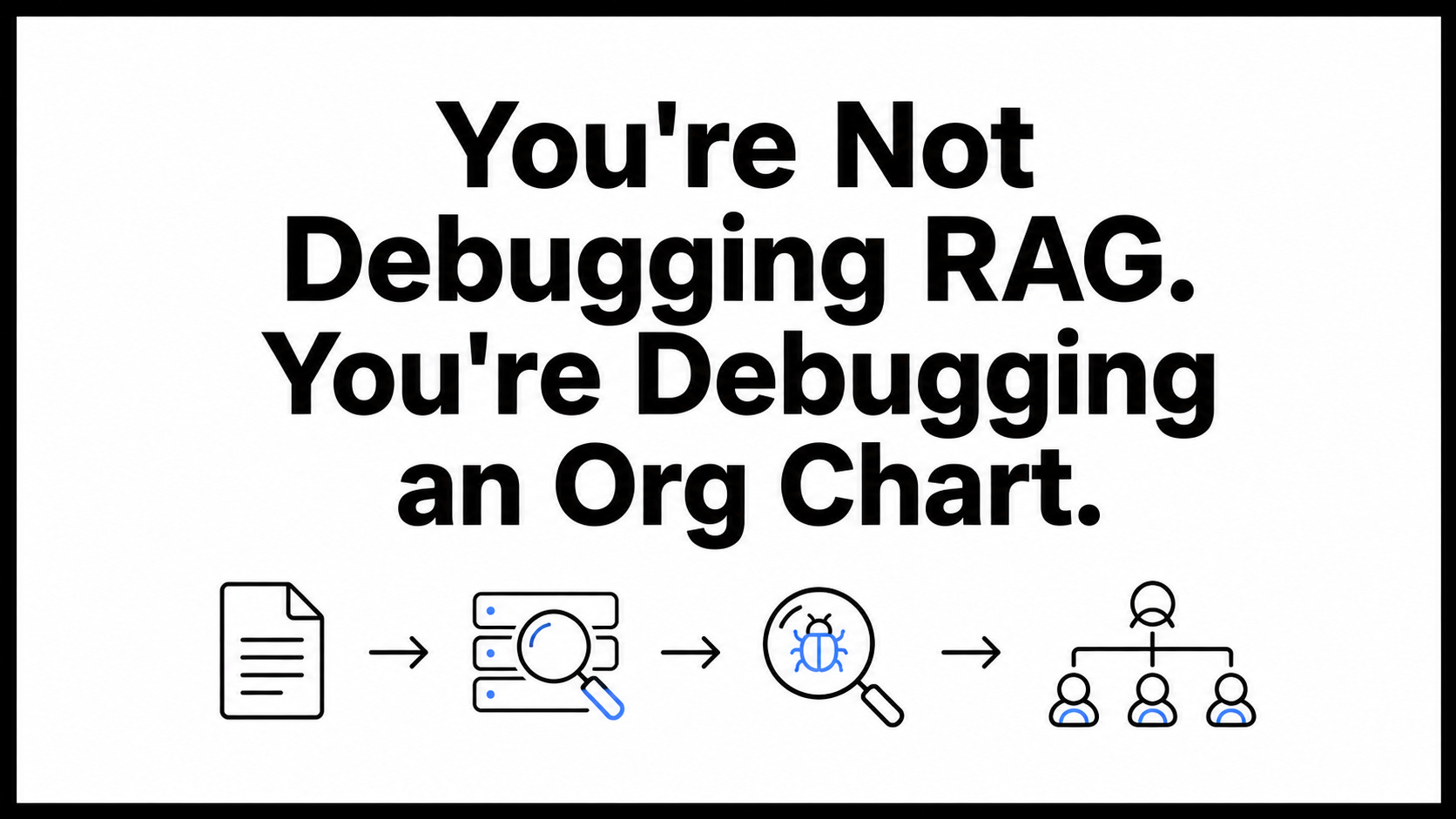
You’re Not Debugging RAG. You’re Debugging an Org Chart.
The answer was wrong. The pipeline is fine. The document was outdated. Nobody owns the document. That’s not a retrieval problem. That’s an accountability problem wearing a retrieval costume.

What This Post Covers
Why RAG failures consistently resolve to accountability gaps, not technical failures.
The 30–45 point accuracy gap between governed and ungoverned data — and why no retrieval tuning closes it.
The four teams who each own a piece of a RAG system and why that produces a system nobody owns.
The three incidents that only look like engineering problems.
What accountability actually looks like in a production RAG deployment — the decisions, the roles, the escalation path.
The conversation engineering has to start and why it will be uncomfortable.
You know the meeting.
Fifteen people on a call. A customer complained that the system gave them wrong information.
A policy number was cited that doesn’t match current policy. The chatbot was confident.
The customer made a decision based on it. Now there’s a problem.
Engineering pulls the logs.
The retrieval scores look fine — top chunk at 0.89 cosine similarity, well above threshold.
The generation faithfulness scores look fine — answer grounded in what was retrieved.
The eval metrics from launch are still on the wiki: faithfulness 0.91, context recall 0.78. Everything in the pipeline is working exactly as designed.
The problem is that the document the pipeline retrieved so faithfully was last updated eleven months ago.
The policy changed in Q1.
The document in SharePoint was updated. The vector index was not.
The customer received an authoritative-sounding answer from a policy that no longer exists.
So whose fault is it?
Engineering built a retrieval pipeline. It retrieves correctly.
The content team updated the policy document. They did their job.
The knowledge management function maintains the document repository. They keep the files organized. The RAG system ingests from that repository. It does what it was configured to do. Legal approved the chatbot deployment. They signed off on the launch.
Everyone did their job.
The customer got wrong information. And now fifteen people are on a call, each of them technically correct that the failure does not belong to them.
You are not debugging a retrieval pipeline. You are debugging who is accountable for the thing that broke.
The Accuracy Gap Nobody Is Closing With Tuning
Start with the number that ends the technical-only conversation.
The same query. The same pipeline.
The same embedding model.
The same retrieval strategy. Identical configuration on every technical dimension.
Governed data: 85–92% accuracy.
Ungoverned data: 45–60% accuracy.
A 30–45 percentage point gap that retrieval algorithm tuning cannot fully close.
That number is from Atlan’s 2026 context layer research, and it is the most important finding in the RAG literature for anyone trying to understand why their system is underperforming.
The vector database is not the problem. The chunking is not the problem.
The embedding model is not the problem. The 30–45 point gap is there before any of those components run. It is a property of the data — its freshness, its consistency, its authority, its provenance — and data quality is a governance property, not a retrieval property.
You can close 25 points of that gap with hybrid retrieval and reranking. That’s documented. That’s real. But if your corpus is ungoverned, the ceiling you’re optimizing against is 60% accuracy, not 92%. The retrieval improvements are real and they’re bounded by the data they operate on.
The tuning conversation is the wrong conversation when the data is the problem. And the data is the problem when nobody owns it.
Four Teams, Zero Owners
Here is the organizational structure of a typical enterprise RAG deployment, stated precisely.
Engineering owns the pipeline — the ingestion job, the vector index, the retrieval logic, the API, the eval harness, the monitoring dashboard. Engineering is accountable for whether the system retrieves and generates correctly given the corpus it was handed.
The content team owns the documents — the policies, the product documentation, the FAQs, the guides. The content team is accountable for whether the documents are accurate and current in the content management system they maintain.
The knowledge management or data governance function owns the repository structure — the folder hierarchy, the metadata standards, the access controls on the file store. They are accountable for whether the repository is organized and accessible.
Legal and compliance owns the deployment decision — whether the system is approved to make the kind of claims it makes, to the kind of users it makes them to, in the regulatory context it operates in. They signed off on the launch.
Now ask: who is accountable for whether a document in the vector index reflects current truth?
Engineering is accountable for whether the ingestion pipeline runs correctly — it does.
The content team is accountable for whether the SharePoint document is correct — it is.
The knowledge management function is accountable for whether the repository is organized — it is. Legal is accountable for whether the deployment was approved — it was.
Nobody is accountable for the gap between those two systems.
Nobody owns the synchronization between SharePoint truth and index truth.
Nobody’s performance review includes a metric for whether the AI system is citing current documents. Nobody was told that when they update a policy document, a downstream system will continue citing the old version until someone triggers a re-index.
The gap is not a technical gap. It is an accountability gap. And accountability gaps do not close when you tune the retriever.
The Three Incidents That Only Look Like Engineering Problems
Incident one: The expired policy answer.
An HR chatbot cites parental leave terms that were updated three months ago. The current policy is more generous.
An employee who accepted an offer based on chatbot guidance is now in a dispute about their entitlement.
The pipeline retrieved correctly from a stale document.
The eval metrics are clean. The failure is that no process exists for the HR content team to signal to the RAG system that a document has been updated. They updated their document. They did their job. The index has no way to know.
The debugging question is not “why did the retriever return that chunk.”
The debugging question is: “what process should have triggered a re-index when the HR team updated the policy, and why does that process not exist?”
The answer to that question requires talking to the HR content team, the knowledge management function, and whoever owns the ingestion pipeline schedule. It does not require opening a vector database console.
Incident two: The three-version answer.
A customer support agent asks about pricing for enterprise plans.
The chatbot returns a confident answer citing a price that was correct six months ago.
The current pricing is different.
The customer was quoted the wrong number and is now in a dispute.
Investigation reveals three pricing documents in the index: the original pricing sheet, a mid-year revision, and the current version uploaded last month.
All three are indexed. All three are retrieved with similar cosine similarity scores for pricing queries. The system returned the highest-scoring one. That happened to be the original.
The debugging question is not “why did the retriever prefer that document.”
The debugging question is: “why are superseded pricing documents still in the index, and who is responsible for removing them when new versions are published?”
That question requires talking to whoever owns pricing documentation, whoever manages the content repository, and whoever made the decision to ingest “all documents in the pricing folder” without distinguishing current from archived. None of those people are on the engineering team.
Incident three: The sensitive document leak.
A junior analyst uses the internal research chatbot and receives an answer that includes detail from a pre-announcement earnings document.
The document was stored in a folder the ingestion service account had access to. It was not supposed to be indexed.
The debugging question is not “why did the retriever find that document.” The debugging question is: “who decided which folders the ingestion service account could read, who reviewed the sensitivity of the content in those folders, and what process should have flagged that document as excluded before the ingestion ran?”
That question requires talking to whoever provisioned the service account, whoever owns the pre-announcement materials, and whoever reviewed the access scope of the ingestion pipeline at launch.
Again: not engineering.
In every case, the technical system worked.
The failure is in the decision that preceded the technical system — the decision about what gets indexed, when it gets updated, and who is accountable for those decisions.
Why Engineering Keeps Getting Called
There is a structural reason engineering ends up in every RAG incident, regardless of where the fault actually lives.
Engineering built the visible system.
The chatbot, the search interface, the API — these are the surfaces users interact with.
When a user gets a wrong answer, the complaint surfaces through the interface. The interface owner gets escalated to.
The interface owner is engineering.
The content team updated a document. That is invisible to users.
The knowledge management function reorganized a folder. Invisible. Legal signed off on a deployment scope. Invisible.
Engineering shipped the chatbot. Visible. Engineering gets the call.
This creates a perverse incentive: engineering is accountable for the outcomes of decisions it didn’t make, made by teams it doesn’t manage, about data it didn’t create, in processes it wasn’t part of.
And engineering, being engineering, tries to fix it technically — better freshness monitoring, more aggressive re-indexing schedules, automated staleness detection. These are real improvements. They don’t resolve the accountability gap. They make engineering more sophisticated at compensating for a governance gap that engineering cannot close.
RAG systems fail more often due to poor data engineering than poor language models. When teams inherit decades of documents, they also inherit formatting inconsistencies, duplicates, version sprawl, and embedded noise. Simply embedding everything and indexing it does not transform it into knowledge. It transforms it into searchable clutter.
Searchable clutter is a governance problem. No retrieval improvement turns clutter into knowledge. That transformation requires someone deciding what knowledge is, who owns it, and who is responsible for keeping it current.
What Accountability Actually Looks Like
The prescription is not an org chart reorganization. It is a set of decisions that have to be made and recorded before the next incident creates the next fifteen-person call.
A named document owner for every indexed source. Not the person who uploaded it. The person or team responsible for its accuracy and currency in the context of the AI system. That person is notified when the document approaches its review date. That person triggers the deprecation process when the document is superseded. That person is the escalation point when the document produces a wrong answer. Without a named owner, the accountability defaults to “the system” — which means it defaults to engineering.
A synchronization contract between content systems and the index. A written agreement that defines: when a document is updated in the source system, what happens to the index. Who triggers the update. What the maximum lag is. Who is notified if the lag exceeds the contract. This is not a technical document — it is an organizational agreement between the team that owns the content and the team that owns the index. It does not exist in most RAG deployments. It should exist before the first document is indexed.
An inclusion policy with a named approver. Before any new data source is connected to the RAG pipeline, a named person reviews the sensitivity classification of the content, approves the access scope, and signs off on the inclusion decision. The service account’s access is provisioned to match the inclusion policy, not the other way around. The three-version pricing problem is solved at the policy level — archived documents are excluded by policy before the ingestion runs — rather than discovered through a customer complaint.
An incident owner who is not engineering. When a RAG system produces a wrong answer, the incident investigation assigns accountability to the team that owned the broken governance property — the content team, the knowledge management function, the approver who included the wrong document — not exclusively to engineering. Engineering fixes the technical failure mode. The governance owner fixes the governance failure. Both are required. Only one is happening in most organizations.
The Conversation Engineering Has to Start
The conversation is not comfortable. It requires going to teams that have no formal relationship with the AI system and telling them their practices now have a new consequence: they determine the accuracy of an AI system that talks to customers, employees, or regulators.
It requires telling the HR content team that when they update a policy document, a downstream process depends on them signaling that update. It requires telling the knowledge management function that their folder structure determines what the AI system considers authoritative. It requires telling legal that their deployment approval included an implicit assumption about data currency that nobody documented.
None of these teams are hostile. None of them chose to create a governance gap. They simply were not told that their existing practices had a new downstream effect. The conversation is about telling them — and then, together, defining the processes that close the gap.
Engineering can start that conversation.
Engineering cannot have it alone, and engineering cannot end it with a technical fix.
The fix requires organizational authority that engineering does not have over content teams, knowledge management functions, and legal — and any attempt to solve a governance problem with a technical solution will produce a more sophisticated version of the same failure mode.
The fifteen-person call happens because nobody had the conversation before the incident. The conversation is uncomfortable. The incident is more expensive.
The Bottom Line
The same query. The same pipeline.
Governed data produces 85–92% accuracy. Ungoverned data produces 45–60% accuracy.
The gap does not close with better chunking, better embeddings, or a smarter retriever. It closes with someone being accountable for the data.
You are not debugging a retrieval failure. You are debugging the absence of a decision about who owns the knowledge the system is allowed to cite. That decision was not made when the pipeline was built. It needs to be made now, before the next incident, in a room that includes people whose names do not appear in your version control history.
The org chart is the bug. The org chart is also the fix.
Go have the meeting.